Back to the directoryFind in the timeline
The Interpretation of Dreams
Freud’s historical theory distinguishes the dream we remember from latent dream thoughts. Explore the difference between interpreting meaning and testing an explanation.
- Author and origin
- Sigmund Freud (Austria)Original language: German (Die Traumdeutung). First published in German as Die Traumdeutung by Franz Deuticke, Leipzig and Vienna, in November 1899 with the title page postdated 1900.
- Genre and form
- Academic (Foundational treatise)Foundational scholarly monographs, experimental treatises, and theoretical volumes written for researchers and students.
- Pairing and evidence
- Contested claimsA work whose claims are disputed in the research literature. Each profile identifies the part of that dispute discussed here.
- Sources inspected
- 2 text/abstract inspected, 2 metadata checked (of 4)2 with the primary text or archive/edition record checked, 0 with an indexed abstract read, 2 with bibliographic metadata checked, 0 not verified.
Attributed cover, adaptation, and trailer links
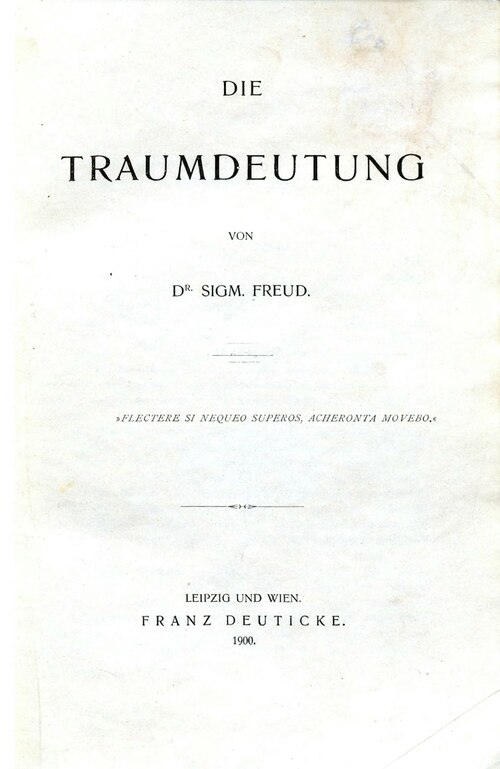
Historical edition or title page
The work and edition history
The original text appeared in November 1899 with a title page dated 1900. The displayed German title page and museum records make that distinction important for the timeline. Later editions and translations should not be assumed to reproduce the original argument unchanged.
Psychological reading
The Freud Museum explains his distinction between manifest content, the remembered dream, and latent dream thoughts. In this account, a wish is disguised through censorship. Read it as an argument about interpretation: what does the interpreter treat as evidence for a hidden meaning?
Why it earns inclusion
The book connects psychology with the interpretation of stories, symbols and the self. It is useful for separating the historical influence of an explanation from the question of how that explanation could be evaluated.
Academic pairing and claim scope
No research paper is formally paired. The museum’s educational account explains the historical theory, while OpenStax’s personality chapter offers a broader perspective on Freud’s place in psychology. These are different tasks from testing a particular interpretation of a dream.
Limits and controversies
OpenStax cautions that many Freudian ideas have not found support in modern research. That is a broad assessment, not a review of every claim in this book. No dream is interpreted for the reader here, and historical influence is not treated as empirical confirmation.
Evidence behind the claims
Museum sources identify November 1899 publication and a title page dated 1900.
The museum’s educational account describes Freud’s manifest–latent distinction and the role of disguised wishes.
OpenStax gives a broad caution about modern research support for Freud’s ideas.
Authors and researchers
- Sigmund Freud. Austrian neurologist and founder of psychoanalysis who authored Die Traumdeutung (1899/1900).
In the Psy101 course
- OpenStax Psychology 2e, section 1.2: History of PsychologyChapter 1, Introduction to Psychology. Historical context. Suggested conceptual background; a mention of this work in the section has not been verified.Places Freud and early psychoanalytic theory in the historical development of clinical psychology.
- OpenStax Psychology 2e, section 4.3: Stages of SleepChapter 4, States of Consciousness. Concept. Suggested conceptual background; a mention of this work in the section has not been verified.Contrasts historical psychodynamic accounts of dreaming with modern physiological and cognitive sleep research.
- OpenStax Psychology 2e, section 11.2: Freud and the Psychodynamic PerspectiveChapter 11, Personality. Concept. Suggested conceptual background; a mention of this work in the section has not been verified.Introduces the psychodynamic perspective on unconscious conflict, defense mechanisms, and clinical interpretation.
Educational reading guide only, not clinical diagnosis or treatment guidance. This course map indicates introductory curriculum relevance rather than clinical proof.See the full course map.
Sources and inspection
Of 4 cited sources, 2 had primary text or archive/edition records checked, 0 had an indexed abstract read, and 2 had bibliographic metadata checked (0 unverified). Literary works and memoirs are distinguished from empirical research studies.
- [2]Freud Museum London. (1899). The interpretation of dreams: Product description. https://shop.freud.org.uk/collections/works-by-freud/products/the-interpretation-of-dreamsReference work. Historical or biographical context.Bibliographic metadata or reference record checkedMuseum shop product description confirms publication of the original text in November 1899; not a full reading of Freud’s book.
- [3]Freud Museum London. (2018, February 16). Dream distortion - the interpretation of dreams - Freud museum London. https://www.freud.org.uk/schools/resources/the-interpretation-of-dreams/dream-distortion/Reference work. Historical or biographical context.Bibliographic metadata or reference record checkedMuseum educational account of manifest and latent content, censorship and wish fulfillment read; historical theory, not empirical validation.
- [1]Instruments), S. F. (documented by H. C. of H. S. (1899). Die traumdeutung (the interpretation of dreams): Historical exhibition record. Franz Deuticke (Leipzig and Vienna, 1899/1900) / Harvard University. https://chsi.harvard.edu/current_exhibitions/freud-interp-drawings/interpretation-dreamsArchive or library record. Work, edition, or catalog record.Edition, title-page, or archive record checkedVisually inspected the local 1900 Franz Deuticke Leipzig und Wien title page and checked the Harvard CHSI exhibition record documenting 1899 publication with 1900 title-page date.
- [4]Spielman, R. M., Jenkins, W. J., & Lovett, M. D. (2020). Psychology 2e. OpenStax. https://openstax.org/books/psychology-2e/pages/11-2-freud-and-the-psychodynamic-perspectiveReference work. Historical or biographical context.Primary text or passage readSelected introductory and concluding passages read, including the chapter’s broad caution about modern research support.