Back to the directoryFind in the timeline
The Principles of Psychology
James describes habit, a flowing stream of thought and the selective work of attention. Read the historical arguments beside the questions psychology still asks.
- Author and origin
- William James (United States)Original language: English. First published in two volumes by Henry Holt and Company, New York, 1890.
- Genre and form
- Academic (Foundational treatise)Foundational scholarly monographs, experimental treatises, and theoretical volumes written for researchers and students.
- Pairing and evidence
- Primary scholarshipA foundational academic book or treatise. Each profile states what was inspected and whether a research paper is paired.
- Sources inspected
- 2 text/abstract inspected, 0 metadata checked (of 2)2 with the primary text or archive/edition record checked, 0 with an indexed abstract read, 0 with bibliographic metadata checked, 0 not verified.
Direct empirical or theoretical sourcePaired academic work
Source independence: Author's own research source.
How it connects: James's 1884 essay in Mind introduced the peripheral bodily-change thesis of emotion that he later integrated into The Principles of Psychology; it is the author's own earlier theoretical argument rather than an independent empirical validation.
Exact claim scope: Covers James's theoretical argument that bodily changes follow directly the perception of an exciting fact and that our feeling of those changes is the emotion; does not claim modern empirical consensus.
Attributed cover, adaptation, and trailer links
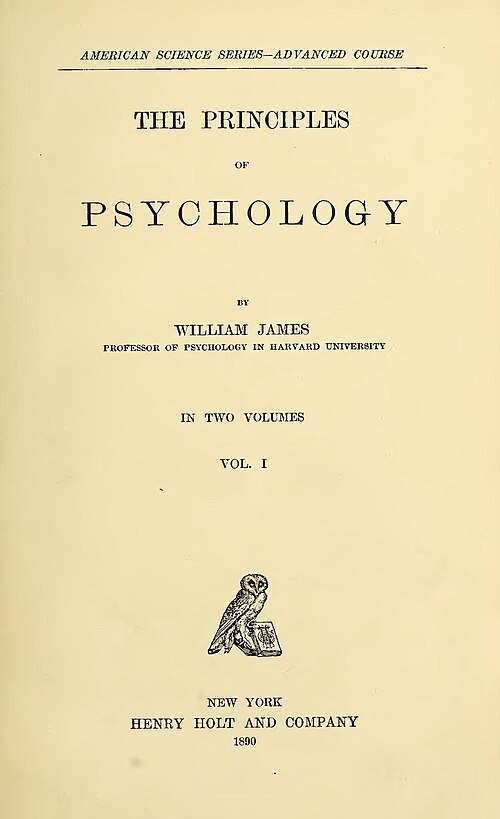
Historical edition or title page
The work and edition history
Published in two volumes by Henry Holt and Company in 1890, The Principles of Psychology brings questions about mind and bodily activity into one large treatise. The displayed Volume I title page identifies the edition; the selected reading focuses on three specific passages.
Psychological reading
In Chapter IV, James treats habit as a broad feature of life and distinguishes innate from acquired habits. In Chapter IX, he describes thought through the metaphor of a flowing stream. In Chapter XI, attention involves focusing on one among several possible objects while withdrawing from others.
Why it earns inclusion
What changes when a repeated action no longer needs your full attention? What does a stream metaphor help us notice about thinking? These passages make the book a useful historical companion to learning, consciousness and attention, while keeping its nineteenth-century physiology in view.
Academic pairing and claim scope
This profile pairs the 1890 treatise with James's own 1884 essay in Mind, "What is an Emotion?" (inspected in full text via Classics in the History of Psychology). In that earlier paper, James argues that bodily changes follow directly the perception of an exciting event and that our feeling of those bodily changes is the emotion. Because the paired article is the author's own theoretical precursor rather than an independent experiment, it documents the origin of the peripheral emotion thesis rather than validating it empirically.
Limits and controversies
James’s descriptions and physiological arguments belong to their historical setting. A primary source helps explain what a theorist proposed; it does not make every proposal a current finding. The paired 1884 essay is his own earlier argument, with no claim of independent validation.
Evidence behind the claims
The title page identifies William James, Henry Holt and Company, Volume I and 1890.
The selected passages discuss habit, the stream of thought and selective attention.
James’s 1884 essay presents a theoretical account relating emotion to felt bodily changes.
Authors and researchers
- William James. American philosopher and psychologist who authored The Principles of Psychology (1890) and formulated the peripheral bodily-change thesis of emotion.
In the Psy101 course
- OpenStax Psychology 2e, section 1.2: History of PsychologyChapter 1, Introduction to Psychology. Historical context. Suggested conceptual background; a mention of this work in the section has not been verified.Situates William James and functionalism in the early institutional history of psychology.
- OpenStax Psychology 2e, section 4.1: What Is Consciousness?Chapter 4, States of Consciousness. Concept. Suggested conceptual background; a mention of this work in the section has not been verified.Connects James's questions about continuous waking awareness and selective attention to introductory discussions of consciousness.
- OpenStax Psychology 2e, section 10.4: EmotionChapter 10, Motivation and Emotion. Concept. Suggested conceptual background; a mention of this work in the section has not been verified.Introduces the historical James-Lange peripheral theory alongside later critiques and cognitive models of emotion.
Educational reading guide only, not clinical diagnosis or treatment guidance. This course map indicates introductory curriculum relevance rather than clinical proof.See the full course map.
Sources and inspection
Of 2 cited sources, 2 had primary text or archive/edition records checked, 0 had an indexed abstract read, and 0 had bibliographic metadata checked (0 unverified). Literary works and memoirs are distinguished from empirical research studies.
- [2]James, W. (1884). What is an emotion? Mind (9, 188-205. https://psychclassics.yorku.ca/James/emotion.htmJournal article. Paired academic research.Primary text or passage readOpened and inspected William James's 1884 Mind article in York University Classics in the History of Psychology.
- [1]James, William, & 1842-1910. (1890). The principles of psychology, volume i. Henry Holt and Company / Project Gutenberg (Ebook 57628). https://www.gutenberg.org/cache/epub/57628/pg57628-images.htmlPrimary literary or historical text. Work, edition, or catalog record.Primary text or passage readVolume I title page and selected passages on habit (pp. 104–105), the stream of thought (p. 239) and attention (pp. 403–404) read. This does not claim a reading of both volumes.