Back to the directoryFind in the timeline
Strange Case of Dr Jekyll and Mr Hyde
Jekyll offers an explanation of his divided self. Does it clarify responsibility or evade it?
- Author and origin
- Robert Louis Stevenson (United Kingdom)Original language: English. The chronology uses the work’s publication year. Images and translations are identified separately.
- Genre and form
- Fiction (Novella)Novels, novellas, short stories, and drama read through an interpretive psychological lens, never as clinical cases.
- Pairing and evidence
- Interpretive readingAn editorial psychological reading of fiction or memoir. A paper is paired only where the connection is substantive; the narrative is not empirical evidence.
- Sources inspected
- 1 text/abstract inspected, 1 metadata checked (of 2)1 with the primary text or archive/edition record checked, 0 with an indexed abstract read, 1 with bibliographic metadata checked, 0 not verified.
Attributed cover, adaptation, and trailer links
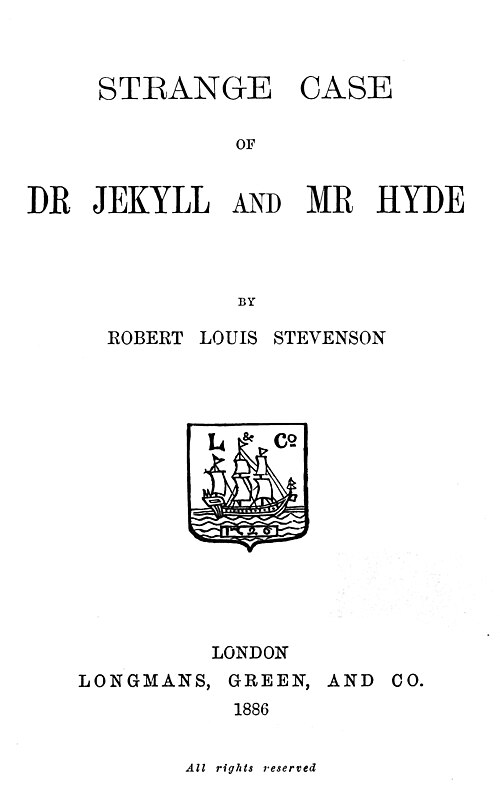
Historical edition or title page

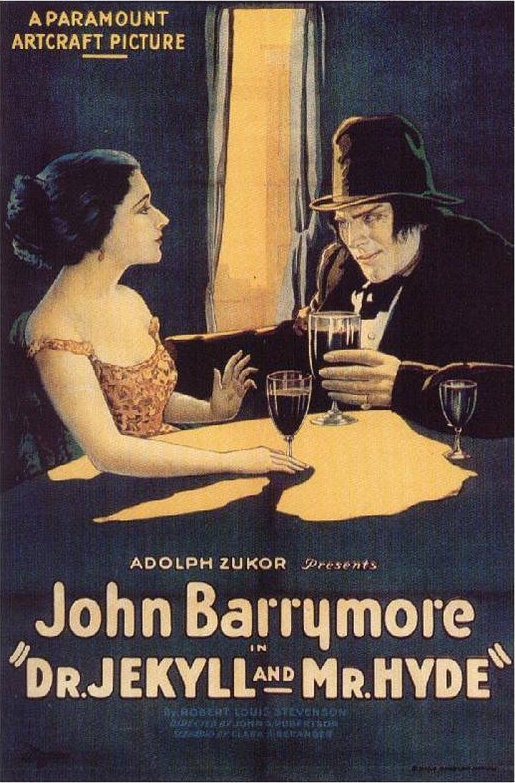
Screen adaptation: Dr. Jekyll and Mr. Hyde (1920 film) (1920)

The work and edition history
The 1886 Longmans title page identifies the edition shown. The selected passage comes from Jekyll’s final account, where the apparent mystery becomes an explanation offered by the man at its center. His explanation is itself something to evaluate.
Psychological reading
Jekyll describes conflicting moral impulses and imagines separating the parts of his identity. He presents himself as both sides of the conflict. Read that account for how a narrator assigns responsibility, rather than treating the transformation as an explanation supplied by psychology.
Why it earns inclusion
Can dividing the self into respectable and disowned parts make responsibility disappear? This novella brings self-presentation, private motives and moral agency into one compact problem. It also lets readers distinguish a metaphor of divided identity from a scientific category.
Academic pairing and claim scope
No research paper is formally paired here. The more useful comparison is with the course’s treatment of self-presentation and theories of personality. Those links provide questions about the self; they do not turn Jekyll’s invented chemical transformation into an empirical mechanism.
Limits and controversies
A supernatural double is not a clinical case. This profile does not use the story to describe or diagnose dissociative disorders or schizophrenia. Jekyll’s own explanation should also be distinguished from a reliable scientific account of why people act against their stated values.
Evidence behind the claims
Jekyll describes conflicting moral impulses and imagines separating the parts of his identity. He presents himself as both sides of the conflict. Read that account for how a narrator assigns responsibility, rather than treating the transformation as an explanation supplied by psychology.
Authors and researchers
- Robert Louis Stevenson. Author
In the Psy101 course
- OpenStax Psychology 2e, section 12.2: Self-presentationChapter 12, Social Psychology. Concept. Suggested conceptual background; a mention of this work in the section has not been verified.Examine the relationship between public identity and private conduct.
- OpenStax Psychology 2e, section 11.1: What Is Personality?Chapter 11, Personality. Concept. Suggested conceptual background; a mention of this work in the section has not been verified.Compare literary identity with introductory questions about personality.
Educational reading guide only, not clinical diagnosis or treatment guidance. This course map indicates introductory curriculum relevance rather than clinical proof.See the full course map.
Sources and inspection
Of 2 cited sources, 1 had primary text or archive/edition records checked, 0 had an indexed abstract read, and 1 had bibliographic metadata checked (0 unverified). Literary works and memoirs are distinguished from empirical research studies.
- [2]Commons, W. (n.d.). Dr. jekyll and mr. hyde (1920 paramount film): Archive metadata. Wikimedia Commons. https://commons.wikimedia.org/wiki/Category:Dr._Jekyll_and_Mr._Hyde_(1920_Paramount_film)Reference work. Historical or biographical context.Bibliographic metadata or reference record checkedFilm title, year and credit metadata checked; no full-film viewing or comparative technique claim.
- [1]Stevenson, Louis, R., & 1850-1894. (n.d.). Strange case of dr jekyll and mr hyde. Project Gutenberg. https://www.gutenberg.org/cache/epub/43/pg43-images.htmlPrimary literary or historical text. Work, edition, or catalog record.Primary text or passage readSelected passages in the linked text were read; this does not claim a whole-book reading. Henry Jekyll’s Full Statement of the Case, passage on moral duality Digital reading edition; its date is not asserted to be the original publication date.