Back to the directoryFind in the timeline
Mrs Dalloway
The same London moment unfolds differently for different minds. Follow awareness, memory and perspective.
- Author and origin
- Virginia Woolf (United Kingdom)Original language: English. The chronology uses the work’s publication year. Images and translations are identified separately.
- Genre and form
- Fiction (Novel)Novels, novellas, short stories, and drama read through an interpretive psychological lens, never as clinical cases.
- Pairing and evidence
- Interpretive readingAn editorial psychological reading of fiction or memoir. A paper is paired only where the connection is substantive; the narrative is not empirical evidence.
- Sources inspected
- 1 text/abstract inspected, 0 metadata checked (of 1)1 with the primary text or archive/edition record checked, 0 with an indexed abstract read, 0 with bibliographic metadata checked, 0 not verified.
Attributed cover, adaptation, and trailer links
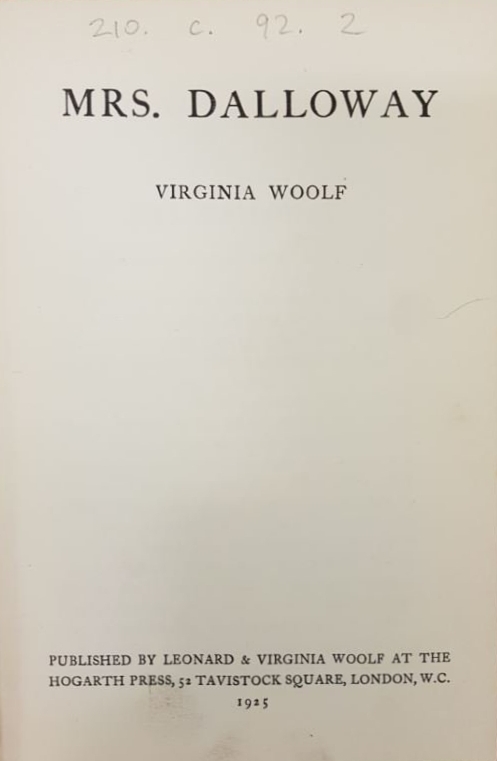
Historical edition or title page

The work and edition history
The Hogarth Press title page shown dates to 1925. The opening moves from Clarissa’s intention to buy flowers to her recollection of Bourton. London’s street life then brings other people and perspectives into view.
Psychological reading
Present sounds and movements lead Clarissa into memories of an earlier morning and Peter Walsh. Later, Septimus Warren Smith appears amid the disturbance around a motor car, with apprehension shaping how the scene is experienced. The text moves across people who share a city without sharing the same inner life.
Why it earns inclusion
How does one ordinary moment contain several different psychological worlds? The juxtaposition gives students a concrete way to discuss awareness, recollection and perspective. It also asks readers to notice what an observer cannot learn simply by looking at someone in public.
Academic pairing and claim scope
No paper is formally paired with this profile. William James’s discussion of the stream of thought is a useful historical reading neighbor, while the course links distinguish consciousness from trauma. Neither is presented as an empirical test of Woolf’s narrative technique.
Limits and controversies
A modernist representation of thought is not a recording of cognition. Septimus is not diagnosed here. This selected reading also makes no general claim about psychiatric practice in the 1920s; a history of treatment would require separate evidence.
Evidence behind the claims
Present sounds and movements lead Clarissa into memories of an earlier morning and Peter Walsh. Later, Septimus Warren Smith appears amid the disturbance around a motor car, with apprehension shaping how the scene is experienced. The text moves across people who share a city without sharing the same inner life.
Authors and researchers
- Virginia Woolf. Author
In the Psy101 course
- OpenStax Psychology 2e, section 4.1: What Is Consciousness?Chapter 4, States of Consciousness. Concept. Suggested conceptual background; a mention of this work in the section has not been verified.Compare awareness of internal and external experience.
- OpenStax Psychology 2e, section 15.6: Trauma- and Stressor-Related DisordersChapter 15, Psychological Disorders. Historical context. Suggested conceptual background; a mention of this work in the section has not been verified.Use trauma as a separate course topic without diagnosing a character.
Educational reading guide only, not clinical diagnosis or treatment guidance. This course map indicates introductory curriculum relevance rather than clinical proof.See the full course map.
Sources and inspection
Of 1 cited sources, 1 had primary text or archive/edition records checked, 0 had an indexed abstract read, and 0 had bibliographic metadata checked (0 unverified). Literary works and memoirs are distinguished from empirical research studies.
- [1]Woolf, Virginia, & 1882-1941. (n.d.). Mrs dalloway. Project Gutenberg. https://www.gutenberg.org/cache/epub/71865/pg71865-images.htmlPrimary literary or historical text. Work, edition, or catalog record.Primary text or passage readSelected passages in the linked text were read; this does not claim a whole-book reading. Opening flower-buying and Bourton recollections; early motor-car scene introducing Septimus Digital reading edition; its date is not asserted to be the original publication date. The digital reading text is a later Harcourt printing; the separate Hogarth title-page image and work chronology refer to 1925.