Back to the directoryFind in the timeline
Hamlet
A soliloquy makes hesitation audible. Compare thought, conscience and the difficulty of acting.
- Author and origin
- William Shakespeare (England)Original language: English. The chronology uses the work’s publication year. Images and translations are identified separately.
- Genre and form
- Fiction (Drama)Novels, novellas, short stories, and drama read through an interpretive psychological lens, never as clinical cases.
- Pairing and evidence
- Interpretive readingAn editorial psychological reading of fiction or memoir. A paper is paired only where the connection is substantive; the narrative is not empirical evidence.
- Sources inspected
- 2 text/abstract inspected, 1 metadata checked (of 3)1 with the primary text or archive/edition record checked, 1 with an indexed abstract read, 1 with bibliographic metadata checked, 0 not verified.
Interpretive thematic pairingPaired academic work
Source independence: Independent of the book’s author.
How it connects: An editorial thematic comparison. This paper does not study the literary work or establish an influence on its author.
Exact claim scope: The review distinguishes maladaptive rumination from more adaptive reflection and discusses its relationship with mood and problem solving. Claims here stay within the inspected abstract.
Attributed cover, adaptation, and trailer links
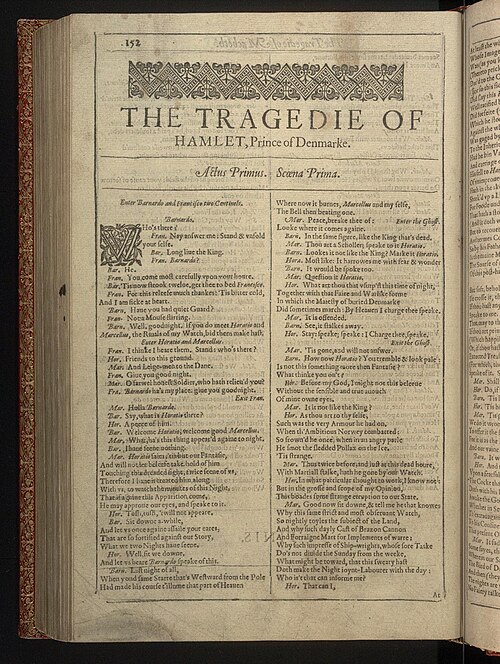
Historical edition or title page

The work and edition history
Folger’s editorial introduction distinguishes the 1603 First Quarto from later versions of the play. The scene linked here is the modern Folger text. Its words should not be assumed to reproduce that first printed version unchanged.
Psychological reading
In Act 3, scene 1, Hamlet weighs suffering, death and uncertainty. His speech connects the pressure of thought and conscience with hesitation and the loss of resolution. The audience hears a decision being repeatedly reconsidered rather than simply announced.
Why it earns inclusion
When does reflection clarify a choice, and when does it make action harder? The soliloquy turns that question into an experience of listening. It is useful for comparing literary inner speech with psychological distinctions between repetitive thinking and productive reflection.
Academic pairing and claim scope
Nolen-Hoeksema, Wisco and Lyubomirsky’s review distinguishes rumination from more adaptive reflection. That distinction supplies a question to bring to Hamlet’s speech. It does not justify diagnosing him, and the paper does not analyze Shakespeare’s play.
Limits and controversies
A performed soliloquy is shaped by dramatic form, actors and audiences. It is not a measurement of a person’s thoughts. Interpretations of Hamlet’s uncertainty remain open; no clinical assessment or claim about a historical Shakespearean diagnosis follows from this reading.
Evidence behind the claims
In Act 3, scene 1, Hamlet weighs suffering, death and uncertainty. His speech connects the pressure of thought and conscience with hesitation and the loss of resolution. The audience hears a decision being repeatedly reconsidered rather than simply announced.
The review distinguishes maladaptive rumination from more adaptive reflection and discusses its relationship with mood and problem solving.
Authors and researchers
- William Shakespeare. Author
In the Psy101 course
- OpenStax Psychology 2e, section 4.1: What Is Consciousness?Chapter 4, States of Consciousness. Concept. Suggested conceptual background; a mention of this work in the section has not been verified.Compare awareness of one’s own thoughts with dramatic inner speech.
- OpenStax Psychology 2e, section 14.4: Regulation of StressChapter 14, Stress, Lifestyle, and Health. Concept. Suggested conceptual background; a mention of this work in the section has not been verified.Contrast repetitive thinking with coping and problem solving.
Educational reading guide only, not clinical diagnosis or treatment guidance. This course map indicates introductory curriculum relevance rather than clinical proof.See the full course map.
Sources and inspection
Of 3 cited sources, 1 had primary text or archive/edition records checked, 1 had an indexed abstract read, and 1 had bibliographic metadata checked (0 unverified). Literary works and memoirs are distinguished from empirical research studies.
- [3]Folger Shakespeare Library. (n.d.). An introduction to this text: Hamlet. https://www.folger.edu/explore/shakespeares-works/hamlet/an-introduction-to-this-text/Reference work. Historical or biographical context.Bibliographic metadata or reference record checkedEditorial introduction on the 1603 quarto and later textual versions read.
- [2]Nolen-Hoeksema, S., Wisco, B. E., & Lyubomirsky, S. (2008). Rethinking rumination. Perspectives on Psychological Science, 3(5), 400–424. https://doi.org/10.1111/j.1745-6924.2008.00088.xJournal article. Paired academic research.Indexed abstract readIndexed abstract read; not a full-paper inspection.
- [1]Shakespeare, W. (n.d.). Hamlet. Folger Shakespeare Library. https://www.folger.edu/explore/shakespeares-works/hamlet/read/3/1/Primary literary or historical text. Work, edition, or catalog record.Primary text or passage readSelected passages in the linked text were read; this does not claim a whole-book reading. Act 3, scene 1, Folger lines 64–96