Back to the directoryFind in the timeline
Jane Eyre: An Autobiography
From enforced dependence to an independent will: read Jane’s voice alongside autonomy and relatedness.
- Author and origin
- Charlotte Brontë (United Kingdom)Original language: English. The chronology uses the work’s publication year. Images and translations are identified separately.
- Genre and form
- Fiction (Novel)Novels, novellas, short stories, and drama read through an interpretive psychological lens, never as clinical cases.
- Pairing and evidence
- Interpretive readingAn editorial psychological reading of fiction or memoir. A paper is paired only where the connection is substantive; the narrative is not empirical evidence.
- Sources inspected
- 2 text/abstract inspected, 1 metadata checked (of 3)1 with the primary text or archive/edition record checked, 1 with an indexed abstract read, 1 with bibliographic metadata checked, 0 not verified.
Interpretive thematic pairingPaired academic work
Source independence: Independent of the book’s author.
How it connects: An editorial thematic comparison. This paper does not study the literary work or establish an influence on its author.
Exact claim scope: The review proposes competence, autonomy and relatedness as psychological needs and examines social conditions that support or undermine motivation. Claims here stay within the inspected abstract.
Attributed cover, adaptation, and trailer links
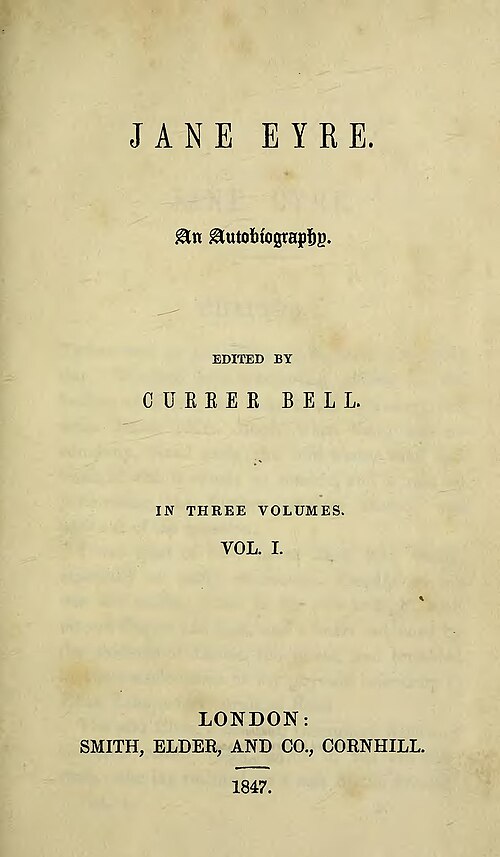
Historical edition or title page

Screen adaptation: Jane Eyre (2011 film adaptation) (2011)
Watch the official Jane Eyre (2011) trailer (Focus Features)
The work and edition history
The 1847 title page names Currer Bell, Brontë’s publishing pseudonym. The narrative places a woman’s account of her own life at its center. Our selected reading moves between Jane’s treatment at Gateshead and her later assertion of an independent will.
Psychological reading
At Gateshead, Jane recalls being told to accept a lower place in the household and describes the injustice of punishment after she resists John Reed. Later, in her conversation with Rochester, she insists on her freedom to leave rather than accepting the image of a trapped bird.
Why it earns inclusion
How can dependence on other people coexist with agency? The contrast between these passages makes power, belonging and self-direction concrete. It invites students to examine who gets to describe a person’s needs and who has the authority to decide for her.
Academic pairing and claim scope
Ryan and Deci’s 2000 review proposes autonomy, competence and relatedness as psychological needs. Bring that framework to Jane’s insistence on self-directed action. This is a thematic comparison across periods, not evidence that Brontë anticipated the theory or that the novel tests it.
Limits and controversies
Retrospective narration and Gothic plotting shape the account. Neither Jane nor another character is treated here as a clinical case. The selected passages support questions about agency; they do not establish a general causal claim about childhood adversity and adult outcomes.
Evidence behind the claims
At Gateshead, Jane recalls being told to accept a lower place in the household and describes the injustice of punishment after she resists John Reed. Later, in her conversation with Rochester, she insists on her freedom to leave rather than accepting the image of a trapped bird.
The review proposes competence, autonomy and relatedness as psychological needs and examines social conditions that support or undermine motivation.
Authors and researchers
- Charlotte Brontë. Author
In the Psy101 course
- OpenStax Psychology 2e, section 10.1: MotivationChapter 10, Motivation and Emotion. Concept. Suggested conceptual background; a mention of this work in the section has not been verified.Compare self-endorsed action with external pressure.
- OpenStax Psychology 2e, section 11.5: Humanistic ApproachesChapter 11, Personality. Concept. Suggested conceptual background; a mention of this work in the section has not been verified.Explore self-concept and personal agency.
Educational reading guide only, not clinical diagnosis or treatment guidance. This course map indicates introductory curriculum relevance rather than clinical proof.See the full course map.
Sources and inspection
Of 3 cited sources, 1 had primary text or archive/edition records checked, 1 had an indexed abstract read, and 1 had bibliographic metadata checked (0 unverified). Literary works and memoirs are distinguished from empirical research studies.
- [1]Brontë, Charlotte, & 1816-1855. (n.d.). Jane eyre: An autobiography. Project Gutenberg. https://www.gutenberg.org/cache/epub/1260/pg1260-images.htmlPrimary literary or historical text. Work, edition, or catalog record.Primary text or passage readSelected passages in the linked text were read; this does not claim a whole-book reading. Gateshead punishment and red-room passage; Rochester conversation in Chapter 23 Digital reading edition; its date is not asserted to be the original publication date.
- [3]Features, F. (n.d.). Jane eyre (2011): Film details. Focus Features. https://www.focusfeatures.com/jane_eyreReference work. Historical or biographical context.Bibliographic metadata or reference record checkedFilm title, year and credit metadata checked; no full-film viewing or comparative technique claim.
- [2]Ryan, R. M., & Deci, E. L. (2000). Self-determination theory and the facilitation of intrinsic motivation, social development, and well-being. American Psychologist, 55(1), 68–78. https://doi.org/10.1037/0003-066x.55.1.68Consulted sourceJournal article. Paired academic research.Indexed abstract readAbstract on printed p. 68 and opening motivation discussion on p. 69 read in the authors’ hosted paper.