Back to the directoryFind in the timeline
Great Expectations
Pip learns to be ashamed of his hands. Follow the moment social judgment becomes self-judgment.
- Author and origin
- Charles Dickens (United Kingdom)Original language: English. The chronology uses the work’s publication year. Images and translations are identified separately.
- Genre and form
- Fiction (Novel)Novels, novellas, short stories, and drama read through an interpretive psychological lens, never as clinical cases.
- Pairing and evidence
- Interpretive readingAn editorial psychological reading of fiction or memoir. A paper is paired only where the connection is substantive; the narrative is not empirical evidence.
- Sources inspected
- 2 text/abstract inspected, 0 metadata checked (of 2)1 with the primary text or archive/edition record checked, 1 with an indexed abstract read, 0 with bibliographic metadata checked, 0 not verified.
Interpretive thematic pairingPaired academic work
Source independence: Independent of the book’s author.
How it connects: An editorial thematic comparison. This paper does not study the literary work or establish an influence on its author.
Exact claim scope: The theoretical model links constructed personal memories with autobiographical knowledge and current goals of the working self. Claims here stay within the inspected abstract.
Attributed cover, adaptation, and trailer links
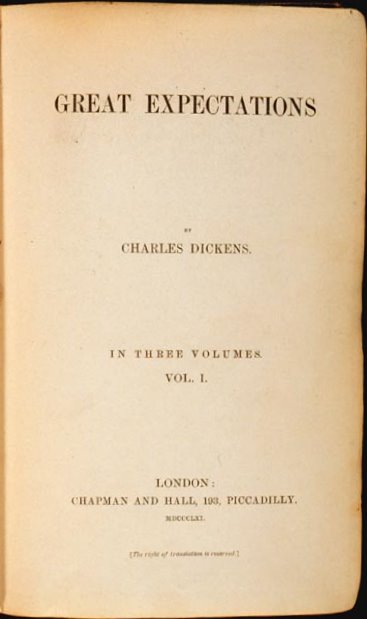
Historical edition or title page

The work and edition history
The displayed Chapman and Hall title page dates the book edition to 1861. Dickens’s first-person narrator looks back on experiences whose significance becomes clearer in retrospect. The selected Satis House passage captures a change in how Pip sees himself.
Psychological reading
Estella mocks Pip’s hands and boots. He recalls that he had not previously felt ashamed of his hands, but begins to judge them through her contempt. The scene gives a precise literary example of a social judgment becoming part of a person’s self-description.
Why it earns inclusion
When does someone else’s opinion become your own standard? Read the scene for the movement from an external insult to internal shame. Pip’s retrospective voice also lets students ask how an older narrator frames an earlier self and what that framing leaves out.
Academic pairing and claim scope
Conway and Pleydell-Pearce model autobiographical memory as construction in relation to knowledge and current goals. Their account offers vocabulary for discussing retrospective narration. It does not prove that Pip’s recollection is accurate, distorted or an example of a measured memory effect.
Limits and controversies
Narrative hindsight is an artistic choice, not a memory experiment. The comparison remains interpretive. The book’s social distinctions also belong to its historical setting; they should not be collapsed into a universal account of ambition or class.
Evidence behind the claims
Estella mocks Pip’s hands and boots. He recalls that he had not previously felt ashamed of his hands, but begins to judge them through her contempt. The scene gives a precise literary example of a social judgment becoming part of a person’s self-description.
The theoretical model links constructed personal memories with autobiographical knowledge and current goals of the working self.
Authors and researchers
- Charles Dickens. Author
In the Psy101 course
- OpenStax Psychology 2e, section 12.2: Self-presentationChapter 12, Social Psychology. Concept. Suggested conceptual background; a mention of this work in the section has not been verified.Discuss self-presentation and the influence of social evaluation.
- OpenStax Psychology 2e, section 8.1: How Memory FunctionsChapter 8, Memory. Concept. Suggested conceptual background; a mention of this work in the section has not been verified.Compare retrospective narration with autobiographical remembering.
Educational reading guide only, not clinical diagnosis or treatment guidance. This course map indicates introductory curriculum relevance rather than clinical proof.See the full course map.
Sources and inspection
Of 2 cited sources, 1 had primary text or archive/edition records checked, 1 had an indexed abstract read, and 0 had bibliographic metadata checked (0 unverified). Literary works and memoirs are distinguished from empirical research studies.
- [2]Conway, M. A., & Pleydell-Pearce, C. W. (2000). The construction of autobiographical memories in the self-memory system. Psychological Review, 107(2), 261–288. https://doi.org/10.1037/0033-295x.107.2.261Consulted sourceJournal article. Paired academic research.Indexed abstract readIndexed abstract read; not a full-paper inspection.
- [1]Dickens, Charles, & 1812-1870. (n.d.). Great expectations. Project Gutenberg. https://www.gutenberg.org/cache/epub/1400/pg1400-images.htmlPrimary literary or historical text. Work, edition, or catalog record.Primary text or passage readSelected passages in the linked text were read; this does not claim a whole-book reading. Satis House card-game scene, Chapter 8 Digital reading edition; its date is not asserted to be the original publication date.